The Simurgh
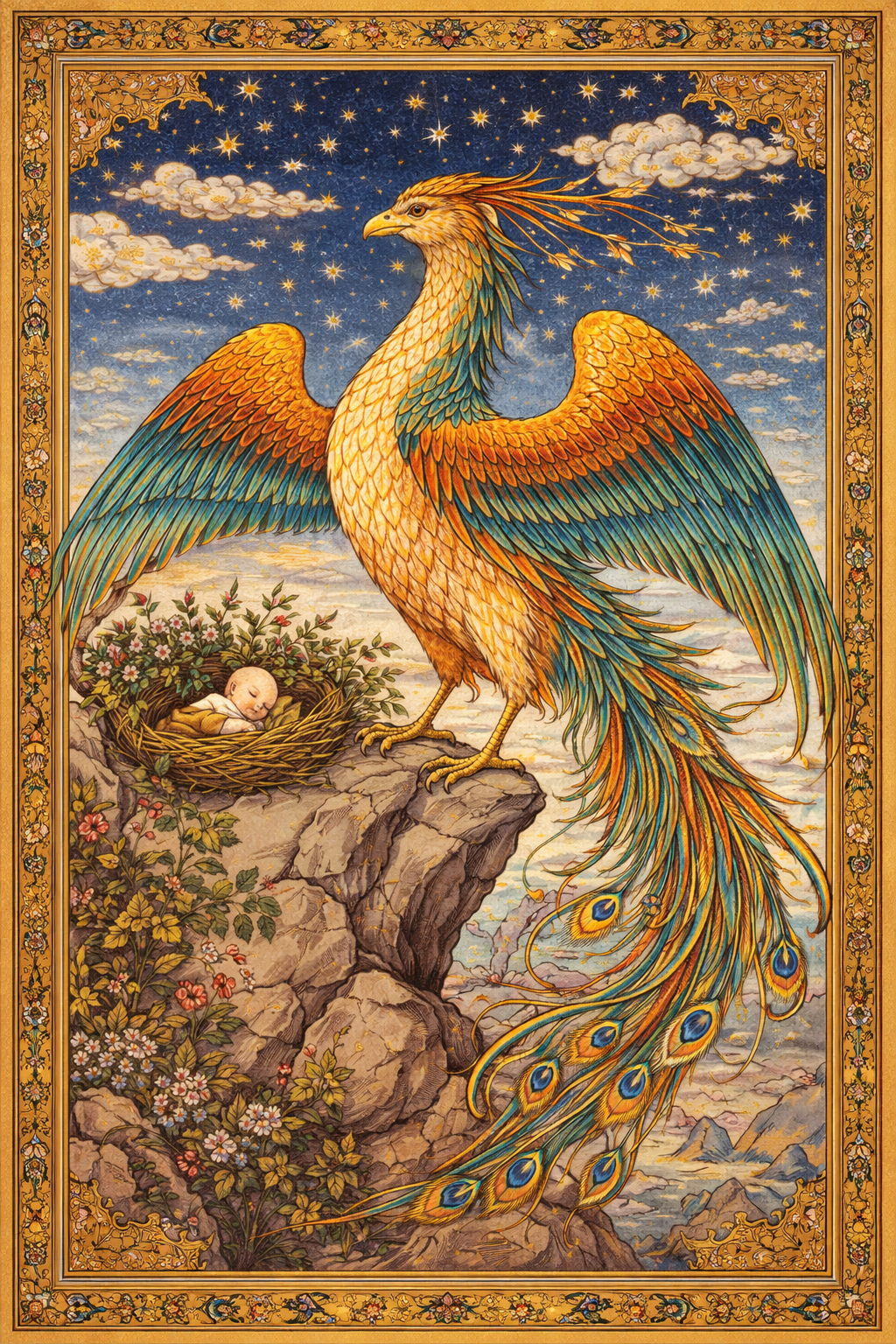
The Simurgh — Sēnmurw in Middle Persian, Sīna-Mrū in Pāzand — is a creature born at the crossroads of philology, cosmology, and myth. Its earliest trace lies in the Avestan mərəγō saēnō, a great raptor whose shadow, already in the oldest hymns, carried healing, protection, and the promise of renewal. What seems at first a fabulous bird is, upon patient reading, a layered symbol: a mediator between worlds, a transmitter of life, and a reminder that decline is not the final word.
The ancient texts linger on the Simurgh’s tree: the all-healing trunk rising from the sea of Vourukaša, the place where the seeds of all plants were deposited. From this axis, the bird lifts, and a thousand shoots spring forth; when it descends, branches break and seeds scatter. The cosmic agriculture of this creature was later complemented by Tištar—identified with Sirius—whose seasonal battle against drought mirrored the struggle against desiccation in the Iranian plateau. The cycle is one of rise, contest, and return, as old as Iranian storytelling itself.
Medieval commentators struggled to classify the Simurgh, some calling her a bird, others a bat, and still others a composite creature reminiscent of the Sasanian carvings at Ṭāq-e Bustān. These debates, often contradictory, reveal a deeper truth: every era remade the Simurgh in its own image. Where Sasanian artisans saw a creature combining the dog’s vigilance, the eagle’s flight, and the peacock’s splendor, the epic poets saw a guardian spirit.
In Ferdowsi’s Šāh-nāma, the Simurgh rescues the abandoned Zāl, nurses him, and returns him to his father bearing a feather — a portable fragment of xᵛarnah, fortune itself. It is with this feather that Rostam’s mother is saved through a proto-caesarean birth, and later that Rostam himself survives the arrows of Esfandiār. The bird knows the secrets of the heavens; she intervenes rarely, but decisively, always at the hinge-points where human fate requires an extraordinary nudge.
Across Kurdish, Armenian, Georgian and even Talmudic traditions, the same pattern repeats: the hero rescues the young of the great bird from a serpent; the bird carries the hero across cosmic boundaries; wounds are healed; journeys are completed; seeds are scattered. These resonances suggest a shared Near Eastern memory — an archaic mythic grammar from which Iranian, Semitic, Caucasian and Indian narratives all drew.
Mystical literature, especially in the Sufi tradition, transformed the Simurgh into a symbol of the divine itself. In ʿAṭṭār’s Manṭeq al-ṭayr, the thirty birds who survive the quest discover that the Simurgh they sought is none other than the perfected reflection of themselves. The image loops back to the oldest Iranian materials: the bird as the giver of life, the bearer of fortune, the custodian of hidden knowledge.
For the MPS, the Simurgh embodies the vocation to rise again — to cultivate learning from the debris of older traditions, to reassemble fragments of languages and myths into structure and meaning. Its flight is not decorative. It is a statement: that scholarship worthy of endurance must carry seeds, must scatter them, and must return, again and again, with renewed strength.